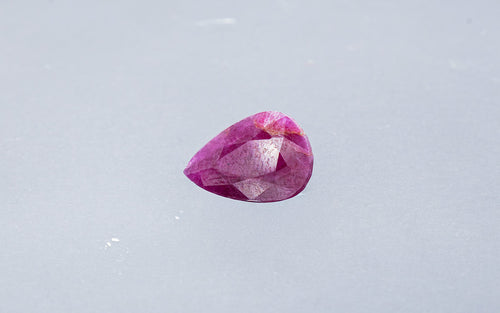


Both natural and lab grown rubies are chemically identical — same aluminum oxide (Al₂O₃) composition, same chromium that gives them that fiery red, and the same 9/10 hardness on the Mohs scale. The real difference comes down to origin, rarity, and price. A natural ruby forms over millions of years deep in the Earth; a lab grown ruby replicates the same geological process in a controlled lab environment in just a few weeks. If you're deciding which one to buy, both are "real" rubies — what changes is their story, value, and what they mean to you.
What Exactly Is a Natural Ruby?

A natural ruby is a gem-quality red corundum formed deep within the Earth's crust over millions of years. The conditions required for its formation are extremely rare — high heat, intense pressure, and the presence of chromium ions, all happening at just the right moment in metamorphic rocks like marble or schist.
That rarity is precisely what makes natural rubies so prized in the gemstone world. As noted gemologist Richard Hughes once put it, "Fine ruby is one of the rarest of all gemstones — rarer, in fact, than diamonds of equivalent quality."
The finest natural rubies historically come from Myanmar's Mogok Valley — famously known for "pigeon blood" red stones — but significant deposits also exist in Mozambique, Madagascar, Sri Lanka, and Thailand.
One thing that surprises many buyers: virtually all natural rubies carry inclusions — tiny natural fingerprints like silk (rutile needles), growth zones, or liquid-filled cavities. Far from being flaws, these inclusions are actually proof of natural origin. A completely eye-clean natural ruby without any inclusions is extraordinarily rare and commands a significant premium.
What Is a Lab Grown Ruby?
A lab grown ruby — also called synthetic ruby or created ruby — is grown in a controlled laboratory environment using the same raw materials as a natural ruby. Scientists replicate the extreme heat and pressure conditions of the Earth to produce a gemstone that is chemically, physically, and optically identical to one mined from the ground.

There are three main methods used to grow rubies in a lab:
| Method | Process | Result |
|---|---|---|
| Flame Fusion (Verneuil Process) | Developed in 1902; aluminium oxide powder is melted in a high-temperature flame and dripped onto a seed crystal | Most affordable; slight curved growth lines visible under magnification |
| Flux Growth | Chemicals dissolved in a molten flux solution slowly crystallise around a seed | More natural-looking inclusions; slower process; higher cost |
| Hydrothermal Growth | High-pressure water-based solution mimics how rubies form in nature | Closest to natural growth; premium quality |
An important distinction: lab grown rubies are not imitation rubies. Imitations like red glass or cubic zirconia merely look red — they have completely different chemical structures. A lab ruby is the real deal; it just didn't need millions of years to get here.
Also Read: Types of Ruby Gemstone
Natural Ruby vs Lab Grown Ruby: Comparison
| Feature | Natural Ruby | Lab Grown Ruby |
|---|---|---|
| Origin | Earth's crust (millions of years) | Laboratory (days to weeks) |
| Chemical Composition | Al₂O₃ + Chromium | Al₂O₃ + Chromium (identical) |
| Hardness (Mohs) | 9 | 9 |
| Colour | Variable; natural chromium distribution | Consistent; precisely controlled |
| Inclusions | Present (proof of natural origin) | Minimal to none |
| Clarity | Mostly included; eye-clean stones are rare | Generally very clean |
| Price per Carat | $500 – $50,000+ | $10 – $200 |
| Investment Value | Strong; appreciates over time | Limited resale value |
| Ethical Sourcing | Can be traced; look for ethical certifications | Conflict-free by nature |
| Certification | GIA, AGL, Gübelin, SSEF | GIA, IGI (clearly labeled as lab-grown) |
| Rarity | Extremely rare at high quality | Produced in quantity |
Colour: Where They Actually Differ
Colour is the single most important quality factor in ruby grading — more so than clarity or cut. Both natural and lab grown rubies can display beautiful red, but how they get there is different.
Natural rubies show a complex, uneven distribution of colour — subtle variations from one zone to another — which gives them depth and character. This natural colour zoning, invisible to most people but visible under magnification, is part of what makes each stone unique.
Lab grown rubies, especially flame fusion stones, tend to have a more uniform, saturated red. It can actually look too perfect — which is sometimes a dead giveaway to a trained eye. Flux-grown and hydrothermal rubies come much closer to natural colour complexity.
The most coveted colour in the ruby world remains "pigeon blood red" — a vivid, fluorescent pure red with a slight blue overtone, traditionally associated with Burmese rubies. Achieving this in lab conditions is possible, but untreated natural pigeon blood rubies command some of the highest prices in the coloured gemstone market.
Price Difference: How Big Is the Gap?
This is where things get very practical. Lab grown rubies are typically priced at just 10–30% of a comparable natural ruby. That gap is significant.
| Quality Level | Natural Ruby (per carat) | Lab Grown Ruby (per carat) |
|---|---|---|
| Commercial quality | $500 – $2,000 | $10 – $50 |
| Fine quality | $3,000 – $10,000 | $50 – $150 |
| Top quality (unheated Burmese) | $15,000 – $50,000+ | $100 – $200 |
For context: a 2-carat heated Burmese ruby of high quality can cost around $12,000 per carat. An unheated stone of the same quality can push past $35,000 per carat. Lab grown rubies simply cannot compete on that investment front — but they can absolutely compete on beauty and wearability.
The price gap also means that with a lab grown ruby, you can afford a significantly larger stone or a richer colour grade within the same budget.
Also Read: How to Wear a Ruby Gemstone
Can You Tell the Difference With the Naked Eye?
Honestly? No — not reliably. Even experienced jewellers cannot consistently distinguish a well-cut natural ruby from a quality lab grown ruby without proper equipment.
What a gemologist looks for under magnification:
- Growth lines: Natural rubies show angular, irregular growth zones. Lab grown (especially flame fusion) rubies show curved striae.
- Inclusions: Natural rubies contain characteristic inclusions like rutile silk, healed fractures, and mineral crystals. Lab rubies are often too clean.
- Fluorescence patterns: Under UV light, natural and synthetic rubies fluoresce differently depending on origin.
- Chemical traces: Advanced spectroscopic testing (like EDXRF or Raman spectroscopy) can detect trace elements that differ between natural and lab-created stones.
This is exactly why certification from a reputable lab — GIA, AGL, Gübelin, or SSEF — matters so much when purchasing a natural ruby. The report will clearly state the stone's origin and whether any heat treatment has been applied.
Ruby Treatments: Something Both Buyers Should Know
Most natural rubies on the market — around 90% — have been heat treated to improve colour and clarity. This is an industry-standard practice and does not make a ruby "fake." However, unheated rubies are significantly more valuable because they've achieved their beauty without any human intervention.
| Treatment Type | Effect | Impact on Value |
|---|---|---|
| Heat Treatment | Improves colour, dissolves silk inclusions | Accepted; slight reduction vs. unheated |
| Fracture Filling (Lead Glass) | Fills cracks to improve clarity | Significant value reduction; must be disclosed |
| Beryllium Diffusion | Alters colour throughout the stone | Controversial; disclosure mandatory |
| No Treatment (Unheated) | Pure natural formation | Highest value; premium pricing |
If you're buying a natural ruby as an investment, always ask for an origin and treatment report. For lab grown rubies, treatment is less common since the stones are already grown to specification.
Investment Value: Which One Should You Buy?
If you're looking at rubies purely as an investment, natural is the clear choice — particularly high-quality, unheated stones with strong origin documentation. Fine natural rubies have a centuries-long track record at auction houses and have consistently appreciated in value over time.
Lab grown rubies, while beautiful and durable, are produced in controlled quantities that can be scaled up on demand. This makes them closer to a consumer product than a collectible. Resale value is limited, and prices may decline as production technology improves.
That said, not every ruby purchase needs to be an investment. If you want a stunning piece of jewellery to wear and love, a lab grown ruby gives you more stone for your money with zero compromise on beauty or durability.
Buy natural ruby if:
- You're looking at long-term investment or heirloom jewellery
- Origin and geological history matter to you
- You want something truly rare and irreplaceable
Buy lab grown ruby if:
- You want maximum size and colour within a budget
- Ethical and conflict-free sourcing is your priority
- You love the beauty of ruby without the premium price

Frequently Asked Questions
Q: Are lab grown rubies real rubies?
Yes, absolutely. Lab grown rubies have the exact same chemical composition (Al₂O₃ with chromium), the same hardness, and the same optical properties as natural rubies. The GIA and other major gemological laboratories certify them as real rubies — simply noting "laboratory grown" as their origin. They are not imitations.
Q: How can I tell if a ruby is natural or lab grown?
With the naked eye, it's nearly impossible to tell the difference. A trained gemologist using microscopy, UV fluorescence testing, and spectroscopic analysis can identify growth patterns and inclusion types that distinguish natural from lab grown stones. Always request a gemological certificate from a reputable lab like GIA or AGL for any significant ruby purchase.
Q: Why do natural rubies have inclusions but lab grown rubies don't?
Natural rubies form in complex geological environments over millions of years, picking up mineral inclusions, growth zones, and healed fractures along the way. Lab grown rubies are created in controlled conditions where variables are tightly managed — the result is a cleaner stone. Interestingly, in the gem world, the presence of natural inclusions (called "silk" in rubies) is considered proof of authenticity, not a defect.
Q: Do lab grown rubies hold their value?
Lab grown rubies have limited resale value compared to natural rubies. Since they can be produced in large quantities, there is no scarcity premium. They are excellent for jewellery but not recommended as an investment or store of value.
Q: Which ruby is better for an engagement ring?
Both work beautifully — ruby scores 9 on the Mohs scale, making it one of the most durable gemstones for daily wear. If budget is a concern, a lab grown ruby allows you to choose a larger, more vividly coloured stone. If sentiment, rarity, and heirloom value matter more, a natural ruby is the better choice.
Q: Is a natural ruby more powerful for astrology than a lab grown ruby?
In Vedic astrology, only natural rubies (Manik) are considered effective as astrological remedies for the Sun. The belief is that the stone's metaphysical properties develop over its millions-of-years journey inside the Earth — something a lab grown ruby cannot replicate, regardless of its identical chemistry.
Q: What is the most expensive ruby in the world?
The Sunrise Ruby — a 25.59 carat unheated Burmese pigeon blood ruby — sold at Sotheby's Geneva for over $30 million in 2015, making it one of the most expensive coloured gemstones ever sold. This gives you a sense of just how rare and valuable top-tier natural rubies can be.
Q: Can a lab grown ruby fade or change colour over time?
No. Lab grown rubies are just as stable and colour-fast as natural rubies. The red colour comes from chromium ions within the crystal structure — it does not fade, change, or degrade with normal wear and exposure to light. Proper care (avoiding harsh chemicals and hard impacts) applies equally to both types.