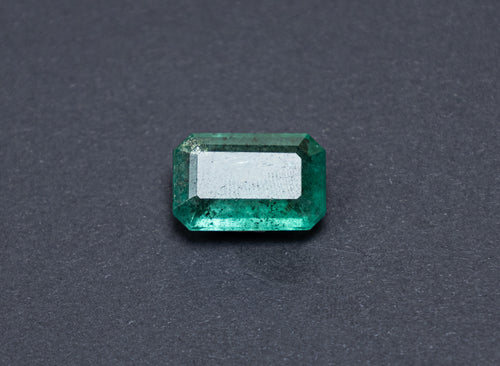


The main types of inclusions in emerald include mineral crystals, fluid-filled cavities, two-phase and three-phase inclusions, growth tubes, and partially healed fractures. Emeralds can also contain fissures and growth features that affect their appearance. These internal characteristics help gemologists understand a stone’s formation, assess its condition, and investigate whether it is natural, laboratory-grown, or treated.
Visible inclusions are common in emerald. Their importance depends on their size, position, and effect on transparency or durability—not simply whether they are present.
What Are Emerald Inclusions?
Emerald inclusions are materials or features enclosed within the gemstone. They can include trapped minerals, fluids, or tiny cavities. In everyday jewellery descriptions, the term is also used broadly for internal fractures and other clarity characteristics.
- They can record part of the stone’s history: Some inclusions become trapped while an emerald grows, while others develop during later geological changes. Their arrangement and relationship with the surrounding crystal can help gemologists interpret how the gemstone formed.
- They are not all the same kind of feature: A small mineral crystal differs from a large fracture reaching the surface. Both may be visible, but they can have very different effects on appearance and condition. Understanding the type is more useful than describing every mark as a flaw.
Types of Inclusions in Emerald: Quick Overview
| Inclusion or Internal Feature | Typical Appearance | What It Can Reveal |
|---|---|---|
| Mineral crystals | Small grains, flakes, dark spots, or defined crystals | Minerals present during formation |
| Fluid inclusions | Tiny cavities containing trapped fluid | Conditions during growth or later healing |
| Two-phase inclusions | Commonly liquid with a gas bubble | The contents of a fluid inclusion |
| Three-phase inclusions | Commonly liquid, a gas bubble, and a solid crystal | Useful evidence in professional identification |
| Growth tubes | Narrow, elongated channels | Features associated with crystal growth |
| Fingerprint inclusions | Curved or branching patterns of tiny inclusions | Partial healing of an earlier fracture |
| Fissures and fractures | Lines, reflective planes, or feather-like areas | Possible clarity and durability concerns |
| Growth and colour zoning | Bands or areas with different colour intensity | Changes during crystal growth |
1. What are Mineral Crystal Inclusions in Emerald?
Mineral inclusions are small crystals enclosed within an emerald. Their appearance depends on the mineral, its size, and the direction from which it is viewed.

- They can take several forms: Some appear as dark specks, while others look like transparent crystals, reflective flakes, or small grains. Minerals documented in emerald include carbonates and pyrite. Their identification may require laboratory analysis rather than visual inspection alone.
- Their impact depends on visibility and location: A small crystal near the edge may be difficult to notice during normal wear. A larger or strongly contrasting inclusion under the centre of the stone can be more distracting. The surrounding structure should also be examined for associated fractures.
2. What are Fluid Inclusions in Emerald?
Fluid inclusions are tiny enclosed cavities containing material trapped within the emerald. They can provide evidence about the environment in which the crystal grew or a fracture healed.
- They may contain more than liquid: A fluid inclusion can contain liquid together with gas or solid material. This is why gemologists describe some as two-phase, three-phase, or multiphase inclusions. These terms refer to the distinct phases observed within the cavity.
- Their contents are not always easy to see: A cavity may look like a small dot or irregular shape at low magnification. Even under a gemological microscope, all its phases may not be clearly visible. Professional interpretation considers lighting, viewing direction, and other evidence.
3. What are Two-Phase Inclusions in Emerald?
A two-phase inclusion contains two distinct phases. In emerald, a familiar example is a liquid-filled cavity containing a gas bubble.
- The bubble sits within a larger cavity: Under suitable magnification, the inclusion may show a rounded bubble surrounded by liquid. The outer cavity can have a different shape from the bubble itself. Identifying that relationship is more informative than simply noticing something round inside the stone.
- A bubble alone does not establish identity: Seeing a bubble does not automatically mean an emerald is glass or laboratory-grown. Bubbles can occur in different settings, including natural fluid inclusions and treatment materials. Gemologists examine the complete inclusion pattern before drawing conclusions.
4. What are Three-Phase Inclusions in Emerald?
Three-phase inclusions in emerald commonly contain liquid, a gas bubble, and a solid crystal. They are among the best-known emerald inclusions because of their importance in gemological research.

- They can have a distinctive appearance: Under magnification, a gemologist may observe a bubble and a small crystal enclosed within the same liquid-filled cavity. Some examples contain a cube-shaped crystal, although the shapes and proportions vary.
- They do not automatically prove Colombian origin: Three-phase inclusions are strongly associated with Colombian emeralds, but similar features occur in emeralds from other sources. GIA has studied examples from several locations. Geographic origin requires a combination of observations and analytical evidence.
5. What are Growth Tubes in Emerald?
Growth tubes are narrow channels within a crystal. In emerald, they may appear as long, fine lines, sometimes arranged in parallel directions.
- They can resemble needles: A tube is a channel rather than necessarily a solid needle-shaped mineral. Its appearance depends on what it contains and how light passes through it. A photograph may not provide enough detail to distinguish the two.
- Their arrangement can help examination: Gemologists consider the direction of tubes relative to the host crystal and other internal features. Growth tubes have been documented in emerald research, but they should not be used as a simple home test for origin.
6. What are Fingerprint Inclusions and Partially Healed Fractures in Emerald?
Fingerprint inclusions are patterns of tiny inclusions that can resemble the curves or branching lines of a fingerprint. They are often associated with fractures that partially healed during the stone’s history.

- They show a process within the gemstone: As a fracture heals, small pockets of fluid can remain along its former path. The resulting pattern may look delicate and lace-like under magnification. Its appearance differs from a single large, open crack.
- Similar-looking patterns need careful interpretation: Fingerprint-like features are not exclusive proof of natural origin. Flux-grown synthetic emeralds can also contain wispy or veil-like patterns. Their detailed appearance and relationship with other features help gemologists distinguish them.
7. What are Fissures and Fractures in Emerald
Fissures are cracks within the gemstone, some of which reach the surface. Although they are structural features rather than trapped materials, they are commonly discussed when assessing emerald inclusions and clarity.
- They can influence appearance and condition: A fracture may reflect light and appear as a bright line or feather-like area. Its significance depends on its size, depth, and location. Large fractures or those near exposed edges deserve particular attention when choosing a stone for a ring.
- Some are filled to reduce visibility: Oil or resin can be introduced into surface-reaching fractures to make them less noticeable. This is clarity enhancement; it does not mean the fracture has disappeared. Ask about treatment before deciding how to wear or clean the jewellery.
8. What are Growth Features and Colour Zoning in Emerald
Growth features and colour zoning are internal characteristics rather than inclusions in the strictest sense. They are still useful when examining an emerald.

- They can show changes during growth: An emerald may contain areas of different colour intensity or visible growth boundaries. Gemologists examine their shape and direction as part of the overall assessment. Uneven colour can also affect how attractive the stone looks face-up.
- Some patterns help identify laboratory growth: Certain hydrothermal synthetic emeralds show chevron-like growth patterns. These are useful clues for an experienced examiner, but a vague zigzag line in a photograph is not enough for identification.
What Does Jardin Mean in Emerald?
Jardin is the French word for “garden,” used to describe the mossy or garden-like appearance of some emerald inclusions. It is a descriptive term rather than a separate scientific inclusion type.
An emerald’s jardin may give it an individual appearance, but the term should not replace an assessment of clarity and condition. An attractive internal pattern and a fracture that weakens the stone need different consideration.
How Do Emerald Inclusions Affect Value?
Inclusions matter because of their effect on the whole gemstone. Counting visible marks alone does not provide a reliable measure of quality.
- Transparency matters: Inclusions that make a stone look cloudy or block its colour can reduce its appeal. A vivid emerald with a few unobtrusive features may look more attractive than one with fewer inclusions but poor colour.
- Position matters: A prominent inclusion beneath the table—the large top facet—may draw more attention than one near the edge. View the stone without magnification first to understand what you will actually notice when wearing it.
- Condition matters: Ask whether fractures affect the proposed setting or intended use. A jeweller or gemologist can help assess concerns that a product photograph does not reveal.
Do Inclusions Prove an Emerald Is Natural?
No. Both natural and laboratory-grown emeralds can contain inclusions. The type, arrangement, and combination of features are more useful than their presence alone.
Synthetic emeralds may contain flux remnants, distinctive growth structures, or other evidence of their growth method. Laboratories can also use spectroscopy when microscopy does not provide a complete answer.

FAQ's
1. What are the most common types of inclusions in emerald?
Common categories include mineral crystals, fluid inclusions, growth tubes, and partially healed fractures. Two-phase and three-phase inclusions are types of fluid inclusions. Fissures are also important in clarity assessment.
2. Are inclusions normal in emerald?
Yes. Visible inclusions are common, and their presence does not automatically make an emerald a poor choice. Evaluate how they affect transparency, appearance, and durability.
3. Are three-phase inclusions found only in Colombian emeralds?
No. Similar three-phase inclusions occur in emeralds from other sources. A laboratory considers multiple lines of evidence before issuing a geographic origin opinion.
4. Does a clean emerald mean it is fake?
No. Natural emeralds without eye-visible inclusions exist, although they are rare. “Eye-clean” also does not mean free of microscopic features. Professional testing is needed to establish identity.
5. Can emerald inclusions be removed?
Most enclosed inclusions cannot simply be removed. Cutting may eliminate some material, but it changes the stone’s dimensions and weight. Fracture filling reduces visibility rather than removing the underlying fracture.
6. Do black spots mean an emerald is fake?
No. Dark spots may be mineral inclusions or other internal features. Their identity cannot be established from colour alone, and they do not by themselves prove whether the emerald is natural or laboratory-grown.