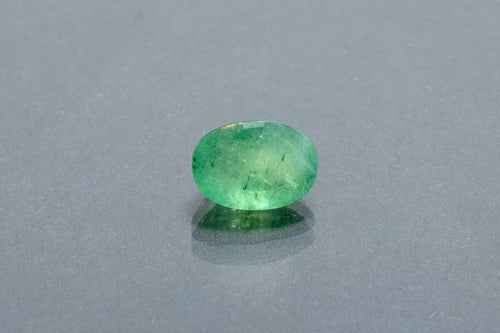


Inclusions are internal features formed naturally inside a gemstone during its growth — trapped crystals, minerals, gas bubbles, or liquids. Cracks (also called fractures) are physical breaks or fissures in the gemstone's structure, which may occur during formation or develop later due to impact, pressure, or thermal stress. The key difference: inclusions are birthmarks a stone is born with; cracks are injuries a stone can acquire. Inclusions rarely threaten durability, while cracks can — and they are two completely different things in gemological evaluation.
Cracks vs. Inclusions: Quick Comparison
| Feature | Inclusions | Cracks (Fractures) |
|---|---|---|
| Definition | Internal material or features trapped during crystal growth | Physical breaks or fissures in the gemstone's structure |
| Formation | During natural growth of the stone | During formation, cutting, handling, or impact |
| Appearance | Crystals, needles, clouds, fingerprints, silk, feathers | White lines, rainbow-like iridescence, jagged breaks |
| Location | Always internal; enclosed within the stone | Can be internal, surface-reaching, or fully on the surface |
| Effect on Durability | Minimal to none, unless severe feather-type fractures | Weakens the stone; can propagate and cause breakage |
| Effect on Value | Varies — minor inclusions lower value; some (silk, fingerprints) can add character | Almost always reduces value; surface-reaching cracks are serious |
| Detectability | Usually requires 10x loupe or microscope | Often visible to naked eye; shows iridescent reflections |
| Can it change over time? | No — inclusions are fixed and permanent | Yes — cracks can propagate with wear, heat, or pressure |
| Treatment Possibilities | Generally untreatable; some clarity enhancements exist (e.g., oiling in emeralds) | Can be filled (fracture filling with resin or glass) to improve appearance |
| Authenticity Indicator | Natural inclusions can confirm a stone is genuine | Presence alone does not indicate authenticity |
What Are Inclusions in Gemstones?
When a gemstone forms deep within the earth over millions of years, it doesn't grow in a sterile environment. Minerals, gases, liquids, and even other crystals can get trapped inside the growing stone. These are inclusions — and every gemologist will tell you they are among the most fascinating aspects of natural gemstones.
Think of inclusions as a gemstone's fingerprints — they provide clues to its origin, history, and formation process. Two stones from different deposits might look identical to the naked eye, but their inclusions can tell them apart under magnification.

Common Types of Inclusions
- Crystal Inclusions Tiny mineral crystals — sometimes even other gemstones — get enclosed within the host stone during growth. A classic example is a ruby crystal trapped inside a sapphire, or a diamond inside another diamond.
- Needle Inclusions (Silk) These long, thin, needle-like inclusions are often made of rutile (titanium dioxide) and can cause the optical phenomenon called asterism — forcing light to reflect in a star-shaped pattern, as seen in star sapphires and star rubies. In the gem trade, fine "silk" in a Kashmir sapphire actually contributes to its coveted velvety blue appearance and can increase its value.
- Feather Inclusions Feather inclusions refer to tiny fractures or breaks within a gemstone that were caused by stress during formation. Unlike the cracks we discuss below, healed feathers — where the fracture was sealed naturally during the stone's growth — are considered inclusions because they are part of the stone's internal character and are fully enclosed.
- Fingerprint Inclusions Fingerprint inclusions look like the whorls and loops of a human fingerprint. They are created from healed partial fractures where the crack filled with liquid or gas during the stone's growth. Under the microscope, they are beautiful and distinctive — and are a reliable indicator of a natural stone.
- Cloud Inclusions Clouds are formed by much smaller inclusions grouped together in one area. Individually, each pinpoint is too small to see, but together they create a hazy or foggy appearance.
- Liquid and Gas Inclusions Some gemstones — particularly certain quartzes and emeralds — trap pockets of fluid or gas during growth. Fluid inclusions may contain liquid, gas, or both, and may also enclose tiny crystals, creating what gemologists call two-phase or three-phase inclusions.
Are Inclusions Always a Problem?
Not at all. Most inclusions present in gem-quality stones do not affect the gem's structural integrity or performance, and are not visible to the naked eye. Many collectors prize inclusions precisely because they prove natural origin. A completely "clean" stone with perfect clarity often raises questions — it may be synthetic or treated.
What Are Cracks in Gemstones?
A crack in a gemstone is a physical break — a separation in the crystal structure. Unlike inclusions, which are part of the stone's interior landscape, cracks represent a disruption of that structure.
Cracks in gemstones are physical breaks or fractures that usually extend from the surface into the interior of the stone. These can occur naturally during formation or later due to improper cutting, handling, or impact.

How Cracks Form
Cracks can form in several ways:
- During formation: Rapid cooling, pressure changes, or tectonic stress during a stone's geological history can create internal fractures.
- During cutting and faceting: Poor technique, excessive heat from grinding wheels, or a hard blow while setting can introduce fractures. Heavily faceted cutting or negligence during processing can cause cracks to appear.
- After purchase: Thermal shock (placing a ring in very hot water, then cold), impact, or prolonged wear can stress weaker areas of a stone and cause new cracks.
What Do Cracks Look Like?
Under a loupe or good lighting, cracks have a distinctive appearance. Unlike inclusions — which have specific structures, appearances, and compositions — a crack may imitate a rainbow-like spectrum due to the way light refracts along the fractured surface. This iridescent flash, sometimes called a "fingerprint effect" in trade parlance, is actually light bouncing off the two sides of the fracture plane. It's one of the most reliable visual clues that you're looking at a crack rather than an enclosed inclusion.
Cracks are usually visible to the naked eye or under magnification and may appear as white lines or jagged breaks. In some cases, they can also cause a visible loss of shine and transparency in that area.
The "Feather" — When Crack and Inclusion Terminology Overlaps
In diamond grading terminology, a "feather" is technically a fracture that reaches the surface of the stone. A feather is defined as a fracture inside the stone that may extend to the surface — and a cavity is an opening that extends into a gem from the surface.
However, in broader gemological usage, a "healed feather" is classified as an inclusion because the fracture is sealed and fully internal. This overlap is a common source of confusion for buyers, which is exactly why context matters when these terms are used.
How Gemologists Identify Cracks and Inclusions

1. Loupe Inspection (10x Magnification)
The standard gemological loupe — a 10x triplet loupe — is the first tool any gemologist reaches for. Held close to the eye with the stone positioned 1–2 inches away in good lighting, it reveals most inclusions and surface-reaching cracks. When examining with a loupe, a trained eye looks for:
- Reflectivity: Inclusions tend to have a consistent internal appearance, while cracks often show iridescent reflections that shift as you rotate the stone.
- Boundaries: Inclusions have defined forms (crystal shapes, needle structures, cloud formations). Cracks typically have irregular, jagged, or flat planar boundaries.
- Depth: Surface cracks can be felt with a needle probe. Inclusions cannot.
2. Microscope Examination
A binocular gemological microscope (typically 10x–40x magnification) with darkfield illumination is far more powerful. Liquid inclusions can take a myriad of appearances inside stones — filling fingerprints, cavities, and even spaces between twinning planes. Under darkfield lighting, inclusions glow from within, while fractures show their characteristic iridescent flash or milky white plane.
3. Light Behavior and Reflection
Rotating a loose stone under a direct light source reveals a lot:
- A crack will often show a flash of color — blue, orange, or rainbow — as light diffracts between the two fracture surfaces. This is the clearest indicator.
- A healed feather inclusion may also show some iridescence, but it is fully enclosed and has no path to the surface.
- Crystal inclusions typically appear as solid, sharply defined objects with their own color or transparency — they don't flash.
An inclusion's position matters significantly — those situated right under the table facet (front and center) are far more visible than those tucked into the pavilion. If the stone has no inclusions visible to the unaided eye, it is described as "eye clean."
Do Inclusions Reduce Gemstone Value?
Yes — but the degree depends heavily on the type, size, location, and number of inclusions.
- A tiny crystal inclusion in the pavilion of a ruby, invisible to the naked eye, may have no meaningful impact on price.
- A large cloud under the table of an emerald that reduces transparency will significantly drop its value.
- Certain inclusions are neutral or even positive. Kashmir sapphire's rutile silk creates that famous velvety texture, and gem dealers know it. Origin-proving inclusions in Burmese rubies or Colombian emeralds can actually command a premium.
Large clouds can affect a diamond's ability to transmit and scatter light, which is where clarity grading becomes critical.
The standard clarity grading systems used by GIA and other labs assess inclusions based on size, number, position, nature, and how much they affect appearance. An "eye clean" stone — even with inclusions under magnification — is generally considered commercially acceptable for most gemstone types.
Do Cracks Reduce Gemstone Value?
Almost always, yes — and the impact is usually more severe than inclusions of comparable size.
Gemstones with cracks are generally considered less valuable, especially if the cracks are deep or reach the surface, as they can lead to further damage or breakage.
Here is how the gemological trade evaluates cracks:
- Surface-reaching fractures are the most problematic. They create a weak point where further breakage can occur during setting, wear, or cleaning.
- Deep internal fractures that do not reach the surface are less of a durability concern but still affect clarity and transparency.
- Fracture-filled stones (where the crack has been treated with resin, glass, or oil) are considered heavily treated and trade at a steep discount. Always ask for disclosure.
Some naturally brittle gemstones are more prone to cracking — emeralds, red coral, and pearls are notable examples. Emeralds are so commonly fracture-filled that the trade has a standard called "jardin" (French for garden) to describe the characteristic web of fractures and inclusions found in virtually every natural emerald. Minor oiling is accepted and expected — heavy fracture filling is not.
Can Cracks Be Mistaken for Inclusions?
Yes, and it happens more often than people realize — even among those with some experience examining gems.
The most common source of confusion is the healed feather. During a gemstone's growth, fractures can sometimes partially heal when minerals and fluids fill the crack over geological time. The healed version looks like an internal fingerprint or feather pattern — technically classified as an inclusion — but it originated as a crack.
Additionally:
- Rainbow iridescence inside a stone might look like a decorative inclusion to an untrained eye, but it is almost always the signature of a fracture plane.
- Fracture-filled treatments can make cracks visually blend with the surrounding material, making them harder to spot without UV light or magnification.
- Cleavage — which is a stone splitting along a crystallographic plane — can be confused with a random inclusion if the examiner isn't familiar with that gem's crystal structure.
When in doubt, a qualified gemologist or a reputable lab report will distinguish between the two clearly.
Why Understanding the Difference Matters When Buying Gemstones
This is practical knowledge that directly protects your investment.
- For durability: A gemstone with deep inclusions but no surface-reaching fractures is generally safer to wear than one with cracks, even if both look similar at a glance. Cracks can propagate — especially when the stone is set in metal, resized, or knocked accidentally. Inclusions usually do not.
- For value assessment: Knowing whether a white line inside a sapphire is a needle inclusion (which may be desirable in Kashmir stones) or a crack (which is always a flaw) can mean a significant price difference. Buyers who cannot tell the difference are at a disadvantage.
- For treatment disclosure: Many treatments specifically target cracks — fracture filling in rubies, oiling in emeralds, glass filling in low-quality corundum. Evidence of such treatments can be identified through internal examination, including healed fractures, fracture-filled cavities, and flash effects. If you know what cracks look like, you are better equipped to recognize treatments that haven't been disclosed.
- For natural vs. synthetic verification: Natural gemstones almost always have inclusions; synthetic ones tend to have different internal features (flux remnants, curved growth lines, gas bubbles in unusual patterns). Understanding natural inclusions helps you assess authenticity.
Conclusion
Cracks and inclusions are not the same thing, and treating them as such is one of the most common mistakes in gemstone evaluation. Inclusions are the internal biography of a natural gemstone — formed during growth, fixed in place, and often a mark of authenticity. Cracks are structural damage — they can be pre-existing, acquired, or a result of treatment — and they almost always have more serious consequences for durability and value.

Frequently Asked Questions
Q1. Are inclusions and cracks the same thing?
No. Inclusions are internal features — crystals, minerals, gases, or liquids — trapped inside a gemstone during its natural growth. Cracks are physical breaks or fractures in the gemstone's structure. They look different under magnification, behave differently over time, and affect a stone's value and durability in different ways.
Q2. Can a gemstone have both inclusions and cracks?
Yes, and in fact most natural gemstones do. An emerald, for example, almost always contains both native inclusions (like two-phase fluid inclusions) and fractures. The two can coexist independently.
Q3. Do inclusions mean a gemstone is fake?
Quite the opposite. Natural inclusions are one of the strongest indicators that a gemstone is genuine. Synthetic gemstones and simulants (imitations) either have no inclusions, different types of inclusions, or artificial ones. A stone with natural inclusions characteristic of its species and origin is a good sign of authenticity.
Q4. Are cracks in gemstones repairable?
Cracks themselves cannot be repaired — but their appearance and stability can be managed. Fracture filling (with resin, glass, or oil) is a common treatment that hides the crack visually. However, this is a temporary treatment, must be disclosed, and significantly reduces a stone's value. A filled crack is still structurally compromised.
Q5. Which affects gemstone value more: cracks or inclusions?
Generally, cracks have a more severe negative impact than inclusions of comparable size. This is because cracks affect both clarity and durability, while inclusions primarily affect clarity. A surface-reaching crack in a ruby is far more damaging to its value than a small crystal inclusion of equal visual prominence.
Q6. How can I identify cracks in a gemstone at home?
Use a bright penlight and slowly rotate the stone. A crack will often show a flash of iridescent color (rainbow effect) as light diffracts between the fractured surfaces. Inclusions, by contrast, appear as fixed internal features that do not produce this iridescent flash. A 10x jeweler's loupe, available for under $20, makes this much easier to see. Look from multiple angles — cracks are often most visible when the light catches the fracture plane at a specific angle.
Also Read: Types of Inclusions in Sapphire