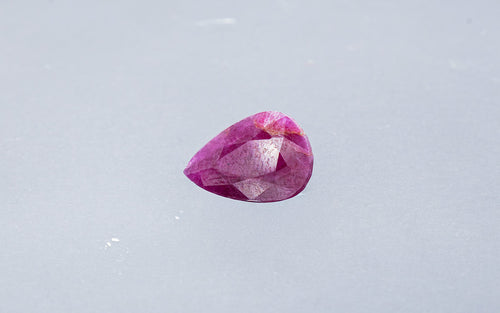


Both Ruby and Pink Sapphire come from the same mineral family — Corundum — but they are two very different gemstones in terms of color, price, rarity, and astrological significance. The simplest way to tell them apart: if red dominates the hue, it's a Ruby; if the stone leans pink, it's a Pink Sapphire. That one distinction in chromium concentration is what separates the "King of Gemstones" from one of the most underrated gems in the market today.
Same Family, Different Identity
Both stones are made of aluminum oxide (Al₂O₃). What gives them their color are trace elements — primarily chromium. Higher chromium = deeper red = Ruby. Lower chromium = pink tones = Pink Sapphire. Simple enough in theory, but in practice, the color boundary between a pinkish-red ruby and a vivid pink sapphire can be surprisingly blurry. This is also why unscrupulous sellers sometimes pass off Pink Sapphires as Rubies — a buyer who doesn't know the difference ends up overpaying significantly.
One quick test: under ultraviolet (UV) light, Ruby fluoresces pink. Pink Sapphire typically does not react the same way. This fluorescence test is one of the first things a gemologist checks when there's confusion between the two.
Ruby vs Pink Sapphire: A Quick Comparison
| Feature | Ruby | Pink Sapphire |
|---|---|---|
| Mineral Family | Corundum (Al₂O₃) | Corundum (Al₂O₃) |
| Color | Deep red to purplish-red | Light pink to magenta |
| Color Agent | High chromium | Lower chromium + iron/titanium |
| Mohs Hardness | 9/10 | 9/10 |
| Birthstone Month | July | September |
| Primary Origins | Myanmar, Mozambique, Sri Lanka | Sri Lanka, Madagascar, Tanzania |
| Price (India) | ₹10,000 – ₹3,00,000+ per carat | ₹2,000 – ₹30,000 per carat |
| Astrological Planet | Sun (Surya) | Venus / Jupiter (varies by school) |
| Rarity | High (especially Pigeon Blood) | More commonly available |
| UV Fluorescence | Glows pink | Does not fluoresce |
Color: The Most Important Difference
This is where most people get confused, and honestly, even gemologists sometimes debate borderline stones.
Ruby's Stone color ranges from vivid blood-red to a slightly purplish-red. The most prized variety — Pigeon Blood Ruby from Burma — has a pure red with a slight blue undertone that gives it an almost glowing quality. The higher the chromium concentration, the deeper and more saturated the red.
Pink Sapphire sits on the lighter side of that spectrum. Its shades range from pale blush pink to a deep, almost hot-pink or magenta. Because pink is technically a lower-saturation version of red, gemological labs like GIA use saturation grading to decide whether a stone is classified as a Ruby or Pink Sapphire. There's no universal agreement on where exactly the line falls — which is why certification from a reputed lab matters so much when buying either stone.
If you're buying a "ruby" that looks more rose-pink than red, ask for a GIA or IGI certificate. It may actually be a Pink Sapphire.

Origin and Availability
Ruby is primarily mined from:
- Myanmar (Burma) — The gold standard. Burmese Pigeon Blood Rubies are among the rarest and most expensive gems in the world
- Mozambique — Produces deep red rubies with good saturation, now a leading source globally
- Sri Lanka (Ceylon) — Known for slightly lighter, pinkish-red rubies
- Thailand & Tanzania — Also significant sources
Pink Sapphire is found in:
- Sri Lanka — A major source, though quality can vary
- Madagascar — Produces high-quality pink sapphires with excellent clarity
- Myanmar & Tanzania — Secondary but notable origins
- Australia — Smaller quantities
Pink Sapphires are generally more available in the market than top-quality Rubies, especially in larger carat sizes. This availability directly affects price.
Price Difference: Why Ruby Costs So Much More
The price gap between these two colored stones is significant, and it comes down to rarity.
A fine-quality natural Ruby — especially one that's unheated and from Burma — commands some of the highest prices in the gemstone world. Auction records for Pigeon Blood Rubies have crossed USD 1 million per carat. For regular buyers in India, quality natural rubies typically range from ₹10,000 to ₹50,000 per carat for standard quality, while premium Burmese or Mozambique rubies can go well above ₹3,00,000 per carat.
Pink Sapphire, on the other hand, is considerably more budget-friendly — usually between ₹2,000 and ₹30,000 per carat for natural stones. This makes it a practical choice for those who love the pink-red color family but don't want to spend heavily.
One important thing to keep in mind: heat treatment is extremely common in both stones. An unheated, certified Ruby or Pink Sapphire will always carry a premium over a treated one. Always ask for a lab certificate that mentions treatment status.
You can learn more about how to wear Ruby gemstone correctly to maximize its benefits.
Hardness and Durability
Both Ruby and Pink Sapphire score 9 out of 10 on the Mohs hardness scale. Only diamonds are harder. This makes both excellent choices for everyday jewelry — rings, bracelets, pendants — without worrying about scratching or damage from regular use.
That said, Ruby sometimes has small surface-reaching inclusions (called silk or needles) that can make it slightly more sensitive to sudden temperature changes or harsh cleaning chemicals. Pink Sapphire tends to have fewer such inclusions and is generally considered more structurally stable.
For either stone, warm soapy water and a soft brush is the safest cleaning method. Avoid ultrasonic cleaners unless a trusted jeweler confirms the stone has no surface fractures.
Astrological Significance in Vedic Astrology
This is where the two stones diverge most sharply for buyers in India.
Ruby (Manik stone) represents the Sun (Surya) in Vedic astrology. It's the primary gemstone in the Navaratna set and is recommended for people with a strong or well-placed Sun in their birth chart. Wearing Ruby is believed to strengthen leadership qualities, decision-making, confidence, and authority. It shows results relatively quickly — often within 72 hours, according to traditional astrology texts.
Pink Sapphire (Gulabi Pukhraj) does not carry the same astrological weight as Ruby. Some astrologers associate it with Venus (Shukra), others with Jupiter (Guru), but there's no unified position across astrological schools. It's sometimes used as a substitute for Ruby, though most classical Vedic astrology texts don't treat it as a full replacement for the Manik stone.
If your astrologer has specifically recommended Ruby for Sun-related remedies, Pink Sapphire is not an equal substitute from a purely astrological standpoint.
| Astrological Factor | Ruby | Pink Sapphire |
|---|---|---|
| Planet | Sun (Surya) | Venus / Jupiter (debated) |
| Associated With | Leadership, power, confidence | Love, creativity, emotional balance |
| Ideal For | Leo ascendant, strong Sun placement | Taurus, Libra, Sagittarius, Pisces |
| Speed of Results | ~72 hours | 2–3 days |
| Navaratna Position | Yes (primary gem) | No |
For a detailed look at Types of Ruby and their astrological use different origins carry different energetic qualities too.
Natural vs Treated: What Buyers Often Overlook
Both Ruby and Pink Sapphire are routinely heat-treated to improve color and clarity. This is an accepted trade practice, but it does impact value. An unheated natural Ruby with a strong red color is exponentially more valuable than a heat-treated one of similar appearance.
If you're considering a natural Ruby, it's also worth understanding the difference between natural Ruby and lab-grown Ruby — lab-grown stones look identical but have no astrological or investment value in traditional Vedic practice.
Which One Should You Choose?
There's no universal answer — it depends entirely on your reason for buying.
Go with Ruby if:
- An astrologer has recommended it for Sun-related remedies
- You want a bold, deep-red gemstone with investment potential
- You're looking for rarity and prestige in your jewelry
- Budget is secondary to quality and astrological effect
Go with Pink Sapphire if:
- You love the pink-red color family but want something more affordable
- You're buying for jewelry purposes (engagement rings, pendants) without astrological intent
- You want a durable, beautiful stone available in larger sizes
- You've been recommended it for Venus or Jupiter-related benefits
Both are excellent gemstones. But they serve different purposes, and confusing one for the other — especially when buying for astrology — can matter quite a bit.

FAQs: Ruby vs Pink Sapphire
Q1. Are Ruby and Pink Sapphire the same stone?
No. Both belong to the Corundum mineral family, but they are classified differently based on color. Ruby is red-dominant due to higher chromium concentration, while Pink Sapphire contains less chromium and shows pink hues. They are distinct gemstones with different prices and astrological associations.
Q2. How do I tell the difference between Ruby and Pink Sapphire at home?
The easiest method is UV light — Ruby glows pink under ultraviolet light, while Pink Sapphire typically does not fluoresce. However, for a definitive answer, always get a certificate from a reputed lab like GIA or IGI. Color alone is not reliable enough for identification.
Q3. Can Pink Sapphire be used as a substitute for Ruby in astrology?
Some astrologers allow it as a partial substitute, but classical Vedic astrology does not treat them as equal. Ruby (Manik) specifically represents the Sun, and no other gemstone fully replicates its planetary connection. If you need a Sun remedy, consult a certified astrologer before substituting.
Q4. Is Pink Sapphire cheaper than Ruby?
Yes, significantly. Natural Ruby can cost anywhere from ₹10,000 to over ₹3,00,000 per carat depending on quality and origin. Pink Sapphire is generally available between ₹2,000 and ₹30,000 per carat, making it a much more accessible option.
Q5. Which is better for an engagement ring — Ruby or Pink Sapphire?
Both score 9 on the Mohs scale, so both are durable enough for daily wear. Pink Sapphire offers more variety in shades and is more affordable in larger carat sizes. Ruby makes a bolder statement and carries more historical prestige. The choice comes down to budget, personal style, and whether the couple has astrological considerations.
Q6. Do both Ruby and Pink Sapphire need to be certified?
Yes, especially if you're buying for astrological purposes or as an investment. A lab certificate confirms the stone is natural, identifies any treatments (like heat treatment), and verifies whether it's actually a Ruby or Pink Sapphire — since sellers sometimes mislabel them.
Q7. Which origin is best for Ruby and Pink Sapphire?
For Ruby, Burma (Myanmar) Pigeon Blood is the most prized origin globally. Mozambique is a strong second. For Pink Sapphire, Madagascar and Myanmar produce the finest quality stones. Sri Lanka is a good source for both, though typically at slightly lower saturation levels.