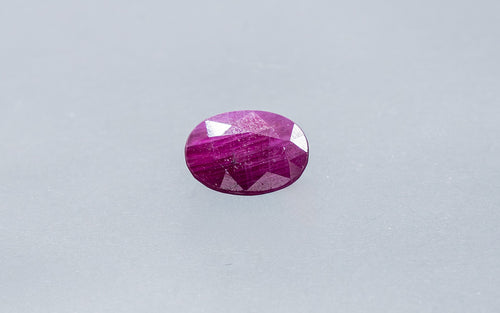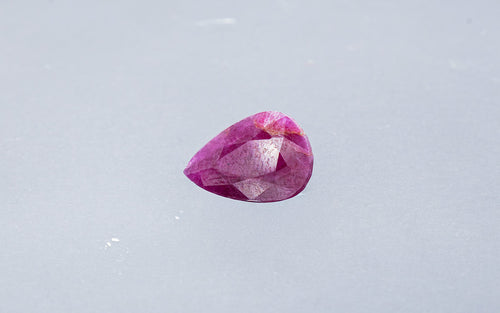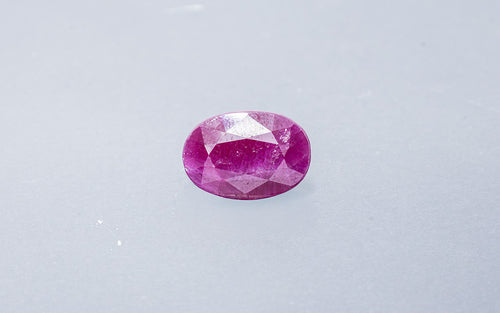


Inclusions are the internal marks that form inside a ruby while its crystal grows. They're basically the clues that tell you whether a ruby is real, how good its quality is, and whether it's been messed with. Some inclusions confirm a ruby is natural and structurally sound.
Others point to treatment, lab-growing, or weak spots that can hurt the stone's durability and its astrological value. A ruby with the right kind of inclusions is worth trusting — one with the wrong kind isn't worth much, no matter how good the color or carat weight looks.
What Exactly Is an Inclusion?
An inclusion is something that gets trapped inside the ruby while it's still forming — a bit like air bubbles frozen inside a block of ice. It locks in the exact conditions (pressure, heat, surrounding minerals) that existed at that moment.
In natural rubies, inclusions split into two broad groups: things like silk needles, mineral crystals, and fingerprint fractures, which point to natural origin and don't change much even after treatment; and things like flux residue, gas bubbles, or oddly geometric patterns, which usually mean the stone was treated or grown in a lab. Telling these apart is the difference between a ruby worth wearing and one that isn't.
Also Check: How to Wear a Ruby Gemstone
The Main Types of Inclusions in Natural Rubies
Natural rubies typically show five kinds of inclusions:
- Rutile silk — fine needles crossing at sharp angles, a classic sign of a natural stone
- Mineral crystals — things like calcite and apatite, trapped in the stone and untouched by treatment
- Fingerprint inclusions — healed fractures with trapped fluid that look like a fingerprint under magnification
- Clouds and milky zones — clusters of fluid or silk that give the stone a hazy look
- Growth patterns — marks that trace how the ruby grew underground

1. Silk (Rutile Needles)
Silk is probably the most recognizable inclusion in a natural ruby. These are ultra-thin needles of rutile (titanium dioxide) that grow along the crystal's natural directions, crossing at 60° or 120° angles under a microscope. They form when the crystal cools slowly and titanium oxide separates out and crystallizes inside it — which is also why they look like threads woven into the stone. If you spot silk, you can be fairly confident the ruby is natural. No known synthetic process reproduces this.
2. Mineral Crystals
As a ruby forms, solid mineral crystals — rutile, apatite, calcite — get trapped inside it and stay exactly as they were, unless the stone is heat-treated, in which case they dissolve or shift position. Under a microscope, intact mineral crystals are a strong sign the ruby hasn't been aggressively heated. So they're a useful check for both natural origin and treatment history.
Also Check: Types of Ruby Gemstone
3. Fingerprint Inclusions
These look like networks of tiny liquid-filled cavities, similar to a human fingerprint. They form when a fracture in the stone heals while surrounded by mineral-rich fluid, trapping it inside. Under magnification, the fluid scatters light and creates that whorled, fingerprint-like pattern. It's a strong indicator of natural origin — no lab-grown ruby produces this.
4. Clouds and Milky Zones
Clouds show up where silk needles or fluid inclusions cluster densely enough to scatter light and fog up the stone. These zones aren't spread evenly — they form in specific spots based on how the crystal cooled at different points. Lab-grown stones don't show this kind of clustering; it's a product of natural, uneven growth, not something a controlled lab process produces.
Natural Inclusions vs. Synthetic Markers

Natural rubies have straight, angular growth lines that follow their hexagonal crystal structure, along with fine silk and untouched mineral crystals. Lab-grown rubies look different depending on how they're made. Flame-fusion (Verneuil) synthetics show curved striae and round gas bubbles.
Flux-grown synthetics often have soft, puddle-like "flux veils" that don't occur naturally. If a ruby shows no inclusions at all under 10x magnification, it's probably synthetic. This is also why proper certification looks at the type and pattern of inclusions, not just a clarity grade — that's how treatment and authenticity actually get confirmed.
The Zero-Inclusion Rule
If a ruby looks completely clean under a 10x loupe, that's usually a red flag, not a good sign. Natural rubies form over millions of years under real geological pressure, so some internal marks are expected — near-perfect clarity is the exception, not the norm. Reactor-grown stones, on the other hand, tend to come out unusually clean because the process is controlled.
Why Examining a Ruby Under a Loupe Matters
A ruby formed in the earth carries intact rutile silk and straight, angular growth lines. A lab-made one carries different tells — round bubbles, curved striae — because of how it was manufactured. These are hard to fake, which is why a loupe check tells you more than the naked eye ever could.
FAQs
1. What are inclusions in a ruby?
Inclusions are internal marks — needles, tiny crystals, fractures, or cloudy patches — that get trapped inside a ruby while it's forming. They act as a natural record of how and where the stone grew.
2. Do all natural rubies have inclusions?
Pretty much, yes. Natural rubies form over millions of years under real pressure and heat underground, so some internal marks are expected. A ruby that looks completely flawless under 10x magnification is more likely to be lab-grown than perfectly natural.
3. How can you tell if a ruby is natural or synthetic just by its inclusions?
Natural rubies usually show fine silk needles crossing at 60° or 120°, straight angular growth lines, and untouched mineral crystals. Lab-grown ones show different signs depending on the process — curved striae and round gas bubbles in flame-fusion stones, or soft puddle-like "flux veils" in flux-grown ones.
4. Does heat treatment change a ruby's inclusions?
Yes. Heat treatment can dissolve or distort rutile silk and shift mineral crystals out of place. So if a ruby's silk and mineral inclusions look intact and undisturbed under magnification, that's usually a sign it hasn't been heat-treated.
5. Are all inclusions bad for a ruby's quality?
No. Fine silk, mineral crystals, and fingerprint inclusions are actually good signs — they confirm natural origin. What lowers quality is heavy cracking, dense cloudiness, or dark inclusions that block light from passing through the stone.
6. Why do gemologists check inclusions instead of just clarity grade?
Because clarity grade alone doesn't tell you the full story. The type, pattern, and condition of inclusions is what actually confirms whether a ruby is natural, where it might be from, and whether it's been treated — clarity grade on its own can't do that.